
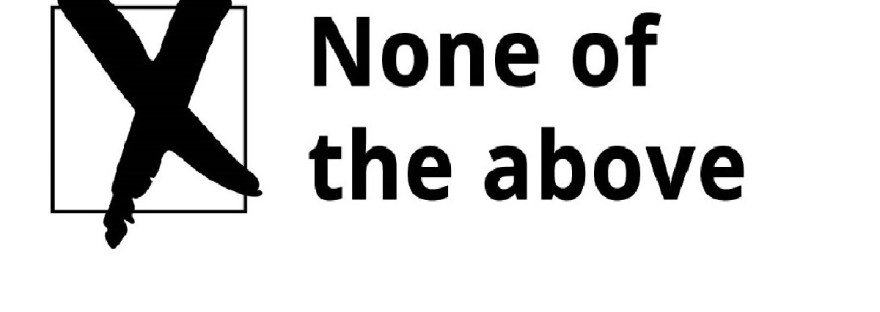
Another federal election is looming and the offer will be, more of the same while a costless option could reshape the political landscape, spicing up the whole process
Canadians will head to the polls sooner than later with Justin Trudeau’s resignation as Prime Minister of Canada combined with his dubious, contested prorogation of Parliament and the actual turmoil in general, let’s be real, the general election is just around the block, only the date needs to be set.
- More of the Same
- Dystopia in Canada
- No Captain On Board
- Electoral Process
- Ballots Tabulation
- Rejected Ballots
- “None of the Above”
- Not A New Idea
- The “NOTA” Provincial Party
- The “None of the Above” Role
- A Statement
- A “None of the Above” Win
- Leverage for Citizens
- Demand A “None of the Above” Option
- Sources
More of the Same
Since 2015, it is the fourth time Canadians are asked to vote for a new government. The wannabe Prime Ministers (PM) have been more or less the same people in each election.
Take a peek at the pictures of the front-runners for those four elections (below), it almost looks like a family album where you can see them aging (or just remember that Canadians got lucky that some of them were not re-elected).
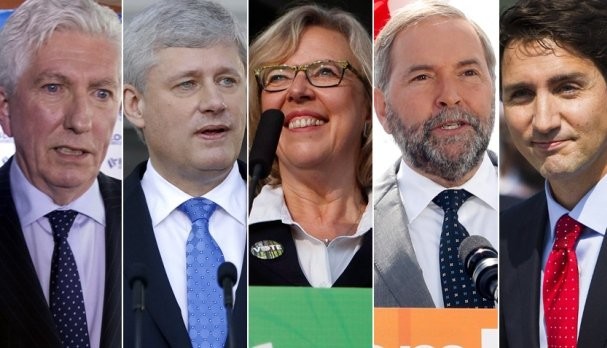
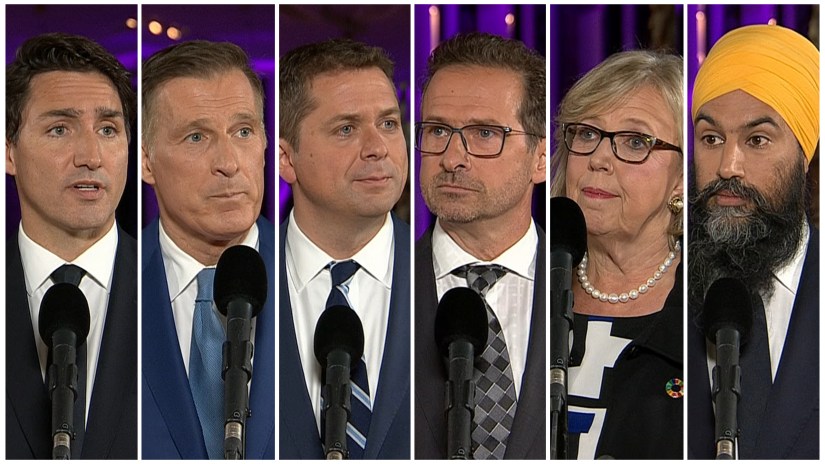
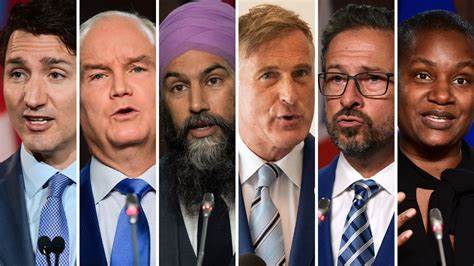
Each election the people are offered these same candidates whether they want them as representatives or not. Because these men and women chose to become politicians therefore citizens have to pick one of them, no other option than to accept and vote for at least one on the list.
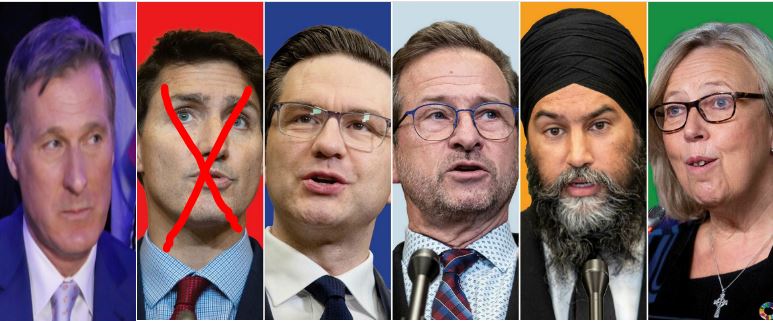
What new government will these same politicians lead? They had the chance to bring-in new ideas or to stand up during recent crisis but most chose the statu quo and sat on their chair.
Are Canadians offered real alternatives? Do they have significant options? For the citizens, there is no way to reject any of these wannabes. There is no diplomatic way to express that ‘none of the people on the ballot’ is the right representative for their district and/or their country.
People say: “You just need to vote at the next election” – but at the next election, it’s still ‘more of the same’, there is no big surprise. nor real change, no improvement, no accountability, nyet, nothing, nada.
Dystopia in Canada
In the actual Canadian electoral system, the Prime Minister position is determined by the party with the most candidates elected, on a “winner-takes-all” basis.
When this system was first introduced, it worked fine since it was a two-party system, those for and those against, accordingly with the concerns of the moment. The vote was representative of the will of the majority.
Nowadays, the electoral process is dystopian because those votes are diluted through a multiple-party system. This means that the Prime Minister is not honourably the leader with the most votes, but rather the leader of the party with the most candidates elected. This is the way Stephen Harper shamelessly became a majority Prime Minister with less than 25% of all the votes cast for his party.
The electoral system in Canada has become unrepresentative of the real will of the majority therefore it stopped serving its initial purpose to represent the people. It is dysfunctional, dystopian, broken, kaput.
No Captain On Board
The governance of Canada is in the void right now. The PM having resigned, his position would normally be filled by the Deputy Prime Minister but the woman already resigned prior to the PM’s resignation (many questions arise about the reasons and timing here).
Meanwhile, our neighbours down South are acting out, taking advantage of the situation. Through it all, Canadians have to sit and watch silently while the boat has no captain and water is pouring in.
Canadians are mistreated by their politicians while it should be the politicians who twist and turn to please the population they begged to represent. Politicians often forget that their role is purely administrative and representative. It ain’t one of control, intimidation and domination. This is exactly the reason why centuries ago, the Universal Declaration of Human Rights was introduced. To prevent leaders’ overreach, the type seen in Canada.
There should be a way for citizens to be able to have their say in the matters concerning their reprensentation and to be able to fire candidates entirely through the electoral process itself if deemed necessary.
The actual system does not permit it other than by voting absolutely for one on the list presented where it often feels like voting for the ‘least-bad’ of a list of bad candidates instead of the best.
There needs to be new options available to allow citizens to vote for real change when it needs to happen: right at the selection of these candidates.
Electoral Process
In Canada, on Election Day, the process is simple. The eligible voters go to their polling station, get a ballot, mark the circle beside one candidate’s name then put their folded ballot in the sealed ballot box. There goes a legitimate vote.

Ballots Tabulation
After the polling stations close, the votes get tabulated. Every ballot with only one circle marked is a valid vote. It gets added in the column of the chosen candidate.
The ballot is rejected if: multiple boxes are checked; it contains other markings; it is altered; it is left blank. In any of these cases, the vote is added in the ‘rejected ballot’ column.
Rejected Ballots
Annuling a vote is a way to protest, sure, but sadly, it has no weight in the actual electoral system of the ‘winner-takes-all’. The winner will still be the candidate with the most valid votes, even if, for example, more votes were rejected than the number of votes cast for the ‘winner’.
If it were the case that more votes came out as rejected, in the actual electoral system, it changes nothing although it should be accounted for since behind such result would hide an insatisfaction of some sort.
Nobody asks questions regarding these rejected votes.
- Why do people mark more than one box?
- Why do others annul their vote with markings or comments?
- Why do some people come all the way to their polling station just to cast a blank vote?
- Why, unfortunately, many people do not even bother showing up to do their civil duty?
Likely because there are people not satisfied with any one candidate presented on the ballot or with the actual electoral process in itself; or maybe for the lack of other options?
There is no option at the moment for citizens to reject or express discontent with the politicians in a democratic way, with civility, to effect real change.
For many years, the only proposed solutions have been the creation of more political parties than needed to govern efficiently, which in the end only dilutes the results and creates more dystopia in the House of Commons.
“None of the Above”
As you read these lines, there is less time left until the next general election than the time needed to reform the entire electoral system.
In the meantime, there is a costless solution to effect real change and to account differently for those ‘rejected votes’ and to maybe bring back some interest in politics which affect everyone’s life.
What if Canadians demanded an additional option on the ballot labelled: “None of the Above”?
Since no ballot has been printed yet, adding an option “None of the Above” would be costless and it could be done right next election, with a political will or a citizens petition (to come shortly). Let’s not forget that politicians were able to seize bank accounts and enact the Emergencies Act in days. Adding this new option should be even easier to introduce (unless politicians lack the confidence to face such challenge from the population they want to represent…).
Not A New Idea
The idea is not new. The “None of the Above” option was seen in the 1983 movie “Brewster’s Millions”.
In the movie, when this option won the election, citizens scored a point! Their voices resonated in the headlines and it triggered a new election.
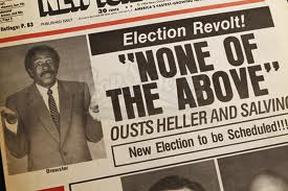
In their case, the “None of the Above” had real value, it cleaned up their political arena. This is exactly what could happen in Canada if the citizens were given the opportunity to express themselves in the same way. It is not because the option is there that people will necessarily select it but having the option in certain cases, could change the outcome of an election and spice up the entire process. It could bring back a sense of democracy or accountability, it could be seen as a democratic ‘People’s Tribunal’.
The “NOTA” Provincial Party
More recently in Ontario, a political party was formed and named “None of the Above” (NOTA) which presents candidates. It is a good way to make a statement but it is an additional party that also dilutes the votes, unless it wins. This concept does decry the need for change in the political realm.
The way of the governed is nearing its end as more people are starting to pay attention to what is being done by their elected officials (for once we can thank their mandates which gave people the time to research and confront their policies).
The “None of the Above” Role
What would the “None of the Above” option do exactly? It would have the potential to change an election’s outcome, partially or entirely.
This process could keep the Members of Parliament (MPs) on edge and inline to really do their best at representing their Constitutents’ and country’s legitimate interests, unlike what we are presently seeing. Many MPs are sitting on their throne, unchallenged, letting their ego and self-interest override their Oath of Office (this can apply to many but not all MPs, some still have integrity).
The addition of the option “None of the Above” can put some leverage into people’s hands, using simple rules and fair play for all.
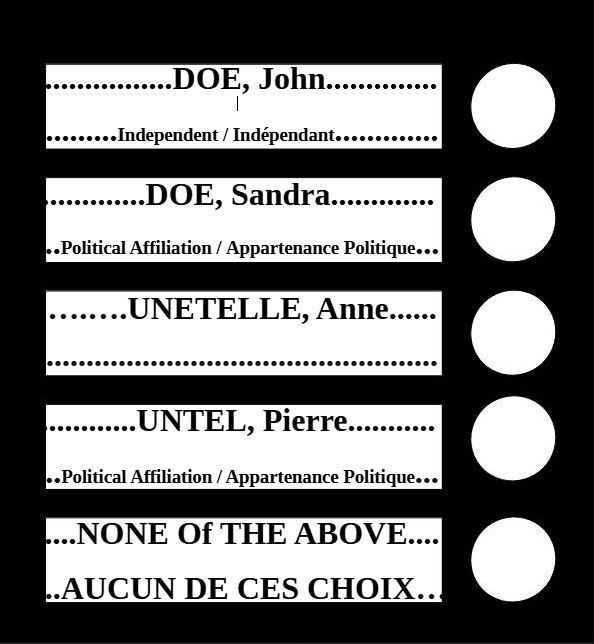
The addition of the “None of the Above” option can be a first step for Canadians to take back their country’s good governance and re-enter a sense of accountability in Parliament. It could at least give them the option to make changes, to take a stand democratically and have a real effect on the political arena.
A Statement
Let’s imagine the “None of the Above” option was to be added. It could enable the people to make a real and effective statement in the case that ‘none of these candidates’ represents their interests, values and/or concerns.
It could also make the statement that these candidates who lost to this option, should not be allowed to run in any further election. The introduction of such a rule would give weight to this vote by the citizens.
It could have the power to expel some wannabes from the professional politician field, making room for newcomers with new ideas and the heart to serve their peers honourably, with integrity.
A “None of the Above” Win
Unlike a new party with candidates, the “None of the Above” option would be at the bottom of every ballot and be a valid vote to be tabulated accordingly. This vote would carry a weight, unlike the rejected votes in the actual system.
What could happen if the “None of the Above” option were to win in an electoral district? It would result in a partial election for this district that would be held at a predetermined delay after the general election. A short delay would be preferable in order for the concerned area to be adequately represented in the House of Commons ASAP.
The parties would have to present only new candidates for the resulting partial election. In the case that a party would not have a replacement for a subsequent election, then this party would have no representation in this partial election. This process would be repeated until a candidate finally gets elected with a majority.
A ‘win’ for the “None of the Above” option would also carry some consequences for the candidates who lose to this option in a district since it would certainly underline the fact that a majority of voters are not satisfied with the suggested candidates for their area.
Leverage for Citizens
Introducing a ban in further elections for those who lost to the “None of the Above” can be considered like a ‘Rejection Vote’ by fellow-citizens. This is where the leverage happens for the voters.
This rule could be perceived as harsh but in many ways it could also send a clear message, democratically, the Canadian way. This rule would be fair and square and it could shakeup the governance of Canada altogether.
This option could clean up the eternal wannabes nobody wants but that the constituents keep on seeing on their ballot. This could be a twist the electoral system needs to go back to the citizens’ interests, opinions and concerns FIRST.
Imagine if in the riding of each party’s leader, the “None of the Above” was to win, none of the actual leaders would be able to run in further elections. This simple addition can rid Canadians of some career politicians.
The “None of the Above” option can become a strategic vote for citizens to express pacifically their discontent, insatisfaction or outrage with certain politicians.
This could be a very simple option combined with simple and clear rules for a healthy democracy in a free country.
Demand A “None of the Above” Option
The Canadian electoral system is obsolete and needs a remodelling which can happen quickly simply by adding a “None of the Above” option, a costless and effective way to bring-in the change Canadians need at this junction in history.
This option could give the citizens the means to make a statement that has weight, to rid the floor of these career-politicians Canadians do not want to see representing them any further. It could bring back some honour, integrity and confidence in the political profession.
Eh Canadians, let’s spice up the next General Election. Let’s demand the “None of the Above” option to make sure we get ‘None of the Same’.
Post Scriptum: This article is an expression of opinion written in accordance with the Article 19 of the Universal Declaration of Human Rights:
“Article 19 Everyone has the right to freedom of opinion and expression; this right includes freedom to hold opinions without interference and to seek, receive and impart information and ideas through any media and regardless of frontiers.”
Sources
- Petition to Re-Open Parliament Immediately
- Federal Court grants urgent hearing in case against decision to prorogue Parliament
- The Canadian Constitution Foundation
- Oaths of Office Regulations
- Trudeau’s Emergencies Act invocation was illegal and unconstitutional – but his government is still fighting against civil liberties
- None Of The Above – NOTA
- Political Parties and Leaders
- Universal Declaration of Human Rights
- Canadian Charter of Rights and Freedoms
- Canadian Constitution
- What is a constitution?
 Inconveniently TRUE